1865 Mobile Campaign:
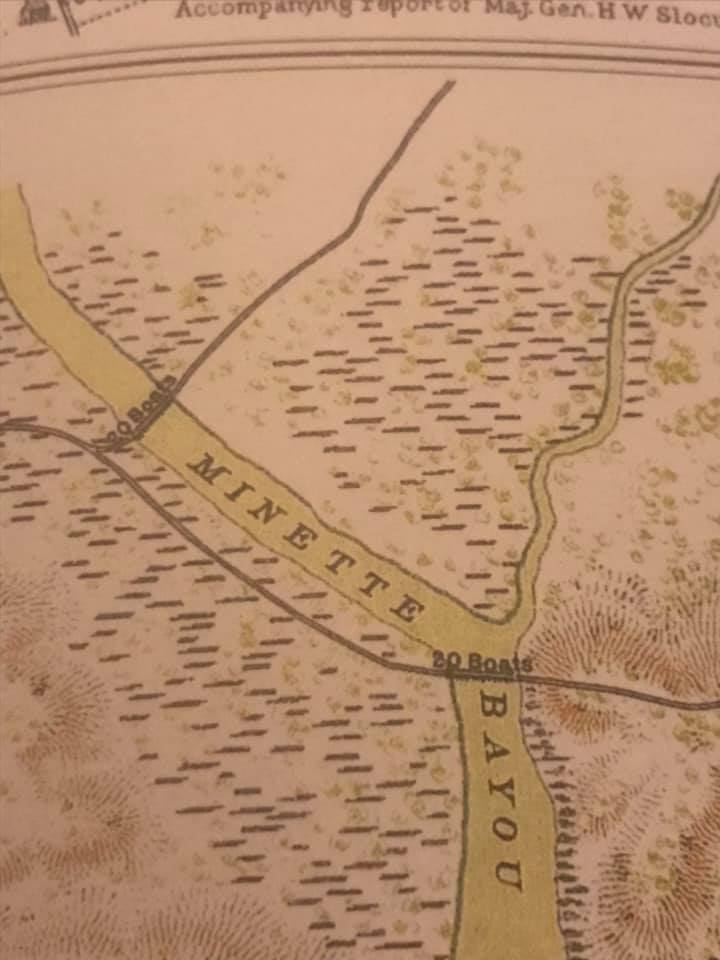
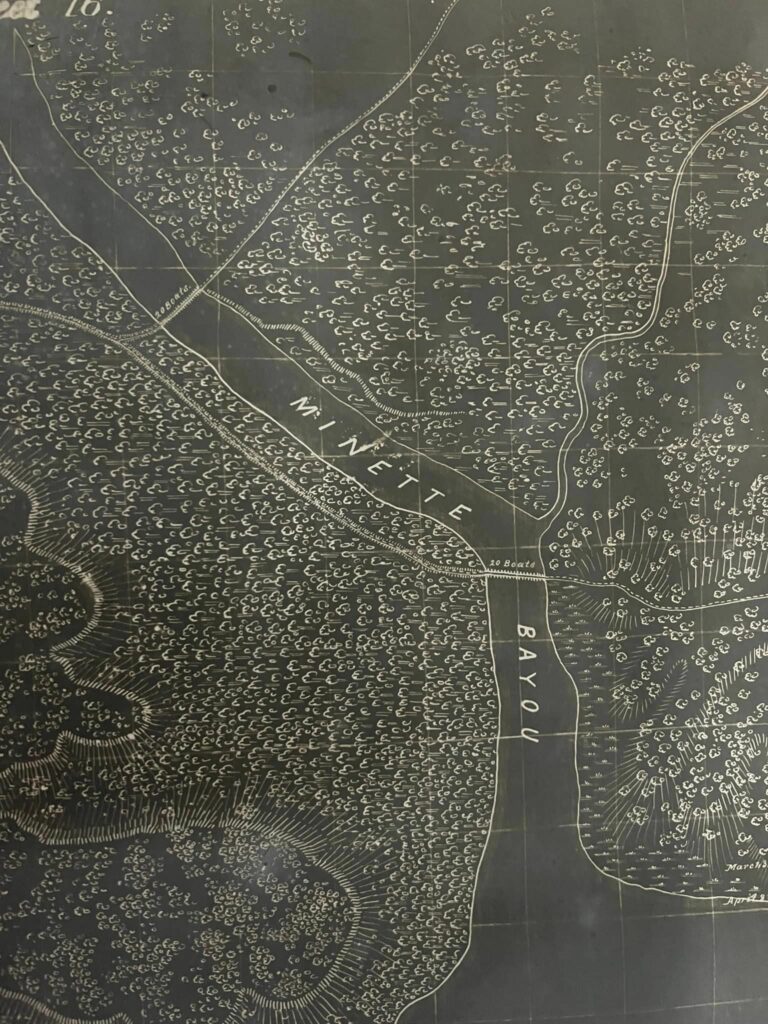
Minette Bayou's Federal Pontoon Bridges
(Excerpts from the Official Records and The History of the Campaign of Mobile)
March 26, 1865:
(General Randall Lee) Gibson already occupied the proposed line, having, the afternoon of the 25th, three thousand in one of battle. That evening, Liddell learned that the Sixteenth Corps was also advancing with the Thirteenth and so fast that he feared he would not be able to get the rest of his forces concentrated in season. He appeared to have been active day and night, eliciting information and making the best possible use of his troops. The next morning (March 26, finding his position was being flanked by the Sixteenth Corps, the proposed offer of battle outside of the works was abandoned. The troops that belonged at Blakely were ordered to retire in that direction. Cockrell withdrew over the Bay Minette bridge, burned it, and, passing around near Blakely, moved out on the Sibley road to watch the Sixteenth Corps.
-From the History of the Campaign of Mobile. [1]
March 26:
On the 26th the Sixteenth Corps moved upon the same road to the South Branch of Bayou Minette, halting at Cyrus Sibley’s Mills, and threatening both Spanish Fort and Blakely…The rebel force, under General Liddell, was posted to resist the advance, but, being disconcerted by the flanking movements of the Sixteenth Corps, fell back into Blakely and Spanish Fort and destroyed the lower bridge on Bayou Minette, cutting off their own communication between the two places except by water.” (93)
– Report of Major General E.R.S Canby, June 1, 1865. [2]
March 26:
General Maury, Mobile:
The enemy have not moved since my last report. Scouts give information that the enemy is endeavoring to throw a bridge across Bay Minette Creek, some three miles below Sibley’s. Have received no information from Spanish Fort as to enemy.
–JNO. R. LIDDELL, Brigadier- General, Commanding (Confederate) [3]
– 16th Army Corps, (Brig. Gen. James I Gilbert) Second Brigade, (Brig. Gen. Garrard) Second Division.
March 27.—Moved some eight miles to Sibley’s Mills, this brigade holding the extreme advance, skirmishing all the way, at which place the command still [March 31] remains, holding the approaches to our army besieging Spanish Fort from the Blakely direction. [4][5]
-Report of Maj. Gen. Andrew J. Smith, U S. Army, commanding Sixteenth Army Corps, of operations March 25-April 9. Headquarters Sixteenth Army Corps, Montgomery, Ala., May 13, 1865.
“Continuing the march on the 26th, with some slight skirmishing we reached Sibley’s Mills, a point on Minette Creek four miles from Spanish Fort and about seven miles from Blakely. On the morning of the 27th, in obedience to instructions from Major-General Canby, the Second Division of my command, Brig. Gen. K. Garrard commanding, was left at this point in an intrenched camp covering the Blakely road where it crosses Minette Creek, in charge of the supply trains of the corps.” (228) [6]
March 27: On the 27th Garrard’s division (Sixteenth Corps) was established in an intrenched camp to cover the right and rear of the army. (94)
–Report of Major General E.R.S Canby, June 1, 1865. [7]
March 27:
The army, with this command in advance, moved on Spanish Fort; met the enemy at Minette Bayou at 8.30 a. m. Left one regiment to hold them in check and moved on the fort about half a mile away; drove the enemy into their works at 9 a. m., and during the night threw up strong works in our front; have since been constantly engaged with the enemy and at work pushing forward our works.
16th Corps, (Col. Charles L. Harris) Third Brigade, (Brig. Gen. Kenner Garrard) Third Division: [8]
March 27: The Nashville left her station near obstructions in Spanish River on the morning of March 27 and arrived at Blakely at 8 a. m. During the forenoon I communicated with Generals Maury and Liddell, who desired the ship placed near the bridge over Minette River, which had been partially destroyed by our forces, and of which the enemy wished to possess themselves. The ship was moored below near Battery Tracy. No evidence of the enemy near the bridge could be seen. Spanish Fort and its intrenchments at this time were invested by the enemy.”
-Report of Lieut. John W. Bennett, C. 8. Navy, commanding Steamer Nashville, of operations March 27-April 11, C. S. Steamer Nashville, Demopolis, Ala., April 25, 1865 (Confederate). [9]
March 29: Hdqrs. Eastern Division, District of the Gulf, Blakely, March 29, 1865—9.20 a.m. Colonel Garner, Chief of Staff:
Sent telegraphic report of casualties at fort yesterday. Will commence work on tread way and piles for wire at Huger today. Lieutenant Elmore, in charge of this work, has been assigned to other duty by some authority not mine. Two men wounded at Minette bridge. No advance of the enemy from Sibley’s Mills. The work here is progressing as fast as possible. Skirmishers attacking Spanish Fort now. Portions of the enemy’s camps in the roads near Bay Minette as far up as Boggy Branch can be reached by guns from Huger. I think the improper direction of the gun yesterday ought not to prevent us from using it today. Solid shot or percussion-shell can be used effectively, and will demoralize the enemy. Will General Maury be over today? The enemy’s skirmish line of yesterday is a line of battle today.
– JNO. R. LIDDELL, Brigadier- General, Commanding. (Confederate) [10]
April 1: Hdqrs. Eastern Division, District of the Gulf, Blakely
Colonel McCown, Commanding Outposts, Saluda Hill:
Colonel: The batteries of Captain Grayson upon our right on Bay Minette have been doing great execution, and General Gibson and Colonel Patton have urgently requested that they be placed in their former position. In view of this fact General Liddell has ordered the batteries to return, and directs that you hold your position on Saluda Hill and your pickets at Sibley’s Bridge until the last moment, thereby enabling the batteries to be withdrawn, which must be done at all hazards should the enemy advance, or endeavor to cut them off.
I am, colonel, very respectfully, your obedient servant,
-L. D. LEWIS, Acting Assistant Adjutant-General (Confederate). [11]
April 1:
Major-General Canby:
The enemy have opened a light battery from a point across Bayou Minette. I have two light guns at the bridge, and will try to find them as soon as the fog and smoke clears away.
– A.J. SMITH, Major- General (Union).[12]
April 1: Found this command at Sibley’s Mills, Ala., guarding the approaches to the flank and rear of our army besieging Spanish Fort.
-16th Army Corps, (Brig. Gen. James I Gilbert) Second Brigade, (Brig. Gen. Garrard) Second Division. [13]
April 2: Maj. Gen. A. J. Smith, Commanding Sixteenth Army Corps:
Sir: General Steele reports that the enemy at Blakely was strongly re-enforced yesterday, and would probably attack him in the morning. General Veatch, now at Origen Sibley’s, and General Garrard have both been instructed to support him in case of necessity. It will be essential to have the bridge across Bay Minette; laid down at once to cooperate promptly with General Steele. You will, therefore, please give the necessary orders for its construction. If it should be under fire from the enemy’s forts, we can change the location hereafter.
– By order of Maj. Gen. E. B. S. Canby: C. T. CHRISTENSEN, Lieutenant-Colonel and Assistant Adjutant-General. (Union) [14]
April 2: Went out on a reconnaissance a few miles and opened communication with General Steele’s army moving against the rebel works at Blakely. While out a torpedo was exploded directly under the brigade commander and staff, but caused no permanent injury excepting killing two horses.
– 16th Army Corps, (Brig. Gen. James I Gilbert) Second Brigade, (Brig. Gen. Garrard) Second Division. [15]
April 2: A regiment of Hawkins’ division was sent to relieve the cavalry in possession of the bridge at Sibley’s Mills…As I had been informed by the general commanding that Blakely was soon to be invested, I thought it best to hold the ground we had gained, as it would deprive the enemy of his works commanding the bridge across Bayou Minette at Sibley’s Mills, and would render it impossible for him to plant subterra shells on the approaches which we could hold.
– MG Fred STEELE, Major-General, Commanding (Union).[16]
April 3: It will be essential to have the bridge across Bay Minette; laid down at once, to co-operate promptly with General Steele. You will therefore please give the necessary orders for its construction. If it should be under fire from the enemy’s forts we can change the location hereafter.
– Maj. Gen. Peter J. Osterhaus to Maj. Gen. A.J. Smith, 3 A.M. [17]
April 3: At 1 a.m. I formed the line and marched in the direction of Blakely, crossed Bayou Minette; near Sibley’s Mills, and reached a point one mile from Blakely at 5 a. m.
– Col. W.B. Kinsey 13th Corps, Third Brigade, First Division (Union) [18]
On the 4th the lower bridge on Bayou Minette was re-established, opening a direct communication between the two wings, and by the afternoon of the 5th Spanish Fort and Blakely were both included in the same general line of investment.[1]
– Report of Major-General E.R.S Canby [1] OR, Vol. 49, Pt. 1, 95.
April 4: Generals Granger and Smith were instructed this evening, in case you should be attacked, to leave here only one line of investing troops, and to re-enforce you with the reserves of the two corps. From the best and reliable information the rebel force at Mobile is not equal to the number of troops now under your command, and it would be sheer desperation on the enemy’s part to attack you. If they should, however, do it, you may rely on the promptest succor by way of Bay Minette bridge.
– J. OSTERHAUS, Major-General and Chief of Staff to Major General Frederick Steele.[19]
April 5: Headquarters of General Steele
Maj. Gen. P. J. Osterhaus, Chief of Staff:
The officer who went to look for a place to build a bridge over Minette Bay did not succeed in finding a suitable place. I will send out again in the morning. It is highly important that a heavy battery be established on the enemy’s right, for as soon as the battery on his left drives away the gun-boats they will probably drop down the stream and make it very hot for Garrard.
– STEELE, Major- General (Union).[20]
April 6: Special Orders, No. 35 Hdqrs. Sixteenth Army Corps, Near Spanish Fort, Ala.
- Battery H, First Indiana Heavy Artillery, will proceed to Blakely, Ala., via pontoon bridge, and report to Maj. Gen. F. Steele for further orders.
- Brig. Gen. J. McArthur, commanding First Division, Sixteenth Army Corps, will cause one regiment of his command to report at the pontoon bridge across Bayou Minette at 11.30 a. m. to-day with arms. They will escort one 30-pounder Parrott battery to within General Garrard’s line at Blakely and return without delay.
III. A salute of twenty-five shotted guns will be fired by the First and Third Divisions of this command at 12 m. to-day, commencing on the right of the Third Division, in honor of the recent victories of the Army of the Potomac near Petersburg, the Army of the Mississippi in North Carolina, and the capture of Selma, Ala., by the Army of the Cumberland. Capt. John W. Lowell, chief of artillery, Sixteenth Army Corps, will make all necessary arrangements and superintend the firing.
– By command of Maj. Gen. A. J. Smith: J. HOUGH, Lieutenant-Colonel and Assistant Adjutant-General (Union).[21]
April 7: Headquarters of General Steele
Col. C. T. Christensen, Assistant Adjutant- General:
The officer who went with Mr. McGill to locate a crossing on Bayou Minette reports in favor of Holyoke Landing, but there Rock Creek, where the bayou is narrow and the ground on both sides good. Are there any further instructions for me regarding this road?
– STEELE, Major- General (Union).[22]
April 7: Hdqrs. Army and Division of West Mississippi
Maj. Gen. F. Steele:
General Canby is not at headquarters at present. If there is good high ground on both sides of the crossing just below Rock Creek the road may be located by that point, as the northern bank of Minette Bayou below the confluence with Rock Creek is swampy and boggy for some distance.
– J. OSTERHAUS, Major-General and Chief of Staff.[23]
April 8: Hdqrs. Army and Division of West Mississippi,
Maj. Gen. F. Steele:
Order a sufficient party to be by daylight at the upper pontoon bridge, laid down this evening, about 500 yards above the old bridge. They will open a road from the bridge to the rear of General Garrard’s position, running substantially parallel to the present road. Through the swamp it must be corduroyed.
– JOS. OSTERHAUS, Chief of Staff (Union). [24]
April 9: Headquarters Thirteenth Army Corps
Brigadier-General Benton, Commanding Third Division:
General: By direction of the major-general commanding you will please detail 100 men, properly officered, to report immediately to army headquarters with tools, for the purpose of repairing the road to the upper pontoon bridge across Bayou Minette.
Very respectfully, your obedient servant,
– W. EMERY, Captain and Assistant Adjutant-General (Union).[25]
April 11: At 7 p. m., in accordance with orders from Brig. Gen. Veatch, my command struck tents and marched in the rear of the First Brigade, First Division, Thirteenth Army Corps, in the direction of Starke’s Landing via the pontoon bridge over Bayou Minette.
– B. KINSEY, Lieut. Col., Commanding Third Brig., First Div., 13th Army Corps.[26]
April 18: Blakely, Ala.
Lieut. Col. C. T. Christensen, Assistant Adjutant-General:
A party of guerrillas is lurking around between this place and Starke’s Wharf. They were at Bayou Minette Bridge last night. I think some cavalry should be left here to scout for this company. It will be necessary to keep a guard at the bridge if it is rebuilt.
– STEELE, Major-General, Commanding (Union).[27]
Notes:
- The lower pontoon bridge (in the vicinity of Hwy 225) was laid across the Minette Bay and U.S. forces crossed over it on April 3.
- The upper pontoon bridge (in the vicinity of Military Bridge Road) was built on the evening of April 8. The road from this bridge to Garrard’s Division’s position at Fort Blakeley was prepared on April 8 – 9. The Federal assault of Spanish Fort occurred on the evening of April 8. The attack of Fort Blakeley on April 9.
[1] Christopher C. Andrews, History of the Campaign of Mobile: Including the Cooperative Operations of Gen. Wilson’s Cavalry in Alabama (New York: D. Van Nostrand, 1867), 46-47.
[2] Official Records of the War of the Rebellion, Vol. 49, pt. 1, 93-94. (hereafter OR)
[3] OR, Vol. 49, pt. 2, 1157.
[4] OR, Vol. 49, pt. 1, 130.
[5] OR, Vol. 49, pt. 1, 130.
[6] OR, Vol. 49, pt. 1, 228.
[7] OR, Vol. 49, pt. 1, 93-94.
[8] OR, Vol. 49, pt. 1, p. 135.
[9] OR, Vol. 49, pt. 1, 319-320.
[10] OR, Vol. 49, pt. 2, 1173.
[11] OR, Vol. 49, pt. 2, 1189.
[12] OR, Vol. 49, pt. 2, 182.
[13] OR, Vol. 49, pt. 1, 130.
[14] OR, Vol. 49, pt. 2, 196-197
[15] OR, Vol. 49, pt. 1, 130.
[16] OR, Vol. 49, pt. 1, 282.
[17] OR, Vol. 49, pt. 2, 209.
[18] OR, Vol. 49, pt. 1, 188.
[19] OR, Vol. 49, pt. 2, 234.
[20] OR, Vol. 49, pt. 2, 248.
[21] OR, Vol. 49, pt. 2, 255.
[22] OR, Vol. 49, pt. 2, 266-267.
[23] OR, Vol. 49, pt. 2, 267
[24] OR, Vol. 49, pt. 2, 287.
[25] OR, Vol. 49, pt. 2, 300.
[26] OR, Vol. 49, pt. 1, 189.
[27] OR, Vol. 49, pt. 2, 404.