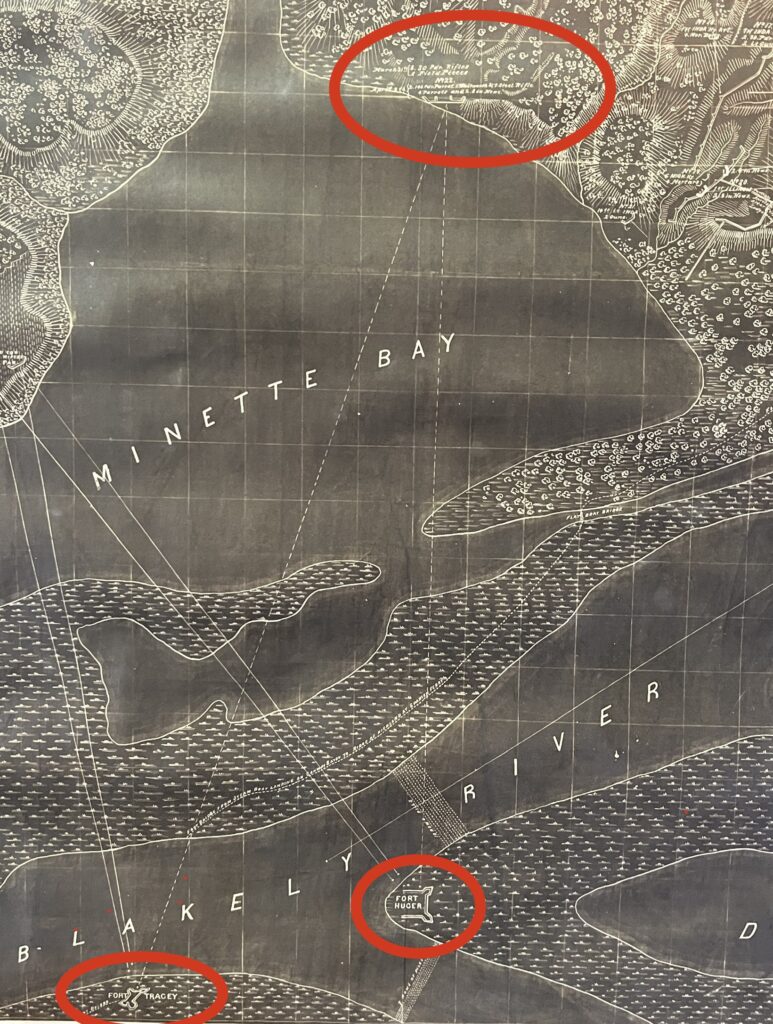
Minette Bay’s Indiana Federal Battery:
“On the 29th of March, I located a battery of eight 30-pounder Parrotts on the southeast shore of Minette Bay, against Batteries Huger and Tracy and the rebel gun-boats, all of which enfiladed the ravine occupied by our right and the Spanish Fort communications by Blakely River. This battery accomplished all its proposed objects quite satisfactorily at ranges varying from 2,400 to 3,300 yards. Fire was opened from this battery on the 31st of March.”
- 5. Report of Bvt. Maj. Miles D. McAlester, Corps of Engineers, U. S. Army, Chief Engineer. Office of Chief Engineer, Army and Division of West Mississippi, New Orleans, June 1, 1865 [1]
In the morning, an examination of the ground off from Carr’s right and along the eastern shore of Minette Bay showed that a battery could be placed on the bluff that would have a plunging fire on Huger. A Whitworth and a steel rifle were put in position there, which drew the fire that had been renewed of Huger from the right flank of the Sixteenth corps and also moved farther up the river a confederate gunboat, which had also been hurling at A. J. Smith’s command large and demoralizing projectiles. [2]
“The details of the 28th and 29th are without special interest except the establishment of a battery of eight 30-pounder Parrotts and two Whitworth guns on the bluff of Bay Minette to counteract the effect of the enfilading fire from the rebel gun-boats and batteries. This was opened with effect on the morning of the 30th, driving off the gun-boats and so far reducing the fire of the batteries (Huger and Tracy) that it gave us no further serious annoyance.” [Note – Canby had the date wrong, should be battery opened on 3/31]
“The Bay Minette battery against Huger and Tracy consisted of two 100-pounder and four 30-pounder rifles.”
- Gen. E.R.S. Canby’s After-Action Report [3]
Thursday, March 30 — “Enemy very quiet all day. But one piece of artillery fired along the entire line, and but little sharpshooting. The line is visited and examined by the major-general commanding. A monitor opens in the evening on our hospital boat. Picket lines of two forces not more than fifty paces apart in several places. Our treadway to Huger is nearly finished. Enemy opens a Parrott battery across Bay Minette on Batteries Huger and Tracy, and on boats attempting to land at those points, thus stopping our steamboat communication with these points today.” — Diary of a Confederate Officer [4]
Friday, March 31. — “Details from Carr’s division had constructed a sunken battery on the shore of Bay Minette near the Whitworth and the steel gun already in position. Eight thirty- pounder Parrotts, of Battery H, First Indiana heavy artillery, Capt. W. P. Wimmer, and Battery K, Capt. Cox, had been placed there the night before, and in the morning opened on some ironclads and transports which were lying with steam up near Forts Huger and Tracy. Two side-wheelers and a trans- port were in a few minutes compelled to move up stream ; but the fourth vessel was of the turtle-back description, and though repeatedly hit by solid shot remained under fire until evening. About one, p. M., a transport attempted to pass down to the fort, but was driven back. The forts were continually signaling, and twice in the following night a transport attempted to run down to them, but was driven back each time. Fort Huger answered the fire of these thirty-pounders briskly, but they sustained no injury. Capt. W. H. Blankenship, of the First Indiana heavy artillery, with his battery (B), eight VIII-inch mortars, had arrived at Stark’s wharf the night of the 28th, and, by working all night in the heavy rain, got his battery on the top of the hill. The 29th, he moved out near Gen. A. J. Smith’s headquarters. The 30th, the battery was divided, forty men and four mortars, under Lieut. Raper, being sent to the extreme left ; with fifty men and the other four mortars he proceeded to Carr’s division ; and at three A. M., of the 31st, had the mortars in position on a knoll in rear of the left of Geddes’ brigade (Battery No. 18) nine hundred yards from the Red fort, but only six hundred from the main works of the garrison in his immediate front. He commenced firing at eight o’clock, and fired thirty-eight rounds.” [5]
Blakeley, March 31, 1865
I understand from the Capt. of the Mary that the enemy are erecting a Batty on Bay Minette, which will fire upon Huger & Tracy, am going to find a position where I can place one to silence it.
- General St. Jno. R Liddell telegram to General Gibson (Confederate) [6]
“March 31, at 8 a. m. enemy’s batteries of 30-pounder Parrotts opened upon us. These guns were planted near the shore of Minette Bay, about half way between the bridge and the right of their line. These works had been observed by us as soon as the mist permitted the view, and had been partially unmasked during the night. As soon as observed preparation was made to shell them, and the discovery immediately communicated to the commanding officer at Huger. The enemy anticipated me by about fifteen minutes, and opened a rapid and accurate fire upon this ship, in the midst of which we had to weigh our anchor, no gun bearing upon the position. By the time the anchor was up they had our range exactly. We responded with a few shots, but finding our elevation inefficient to reach, we steamed a little above Tracy and anchored beyond range. The ship was struck eight times, but without serious injury.”
- W. BENNETT, Lieutenant-Commanding – C.S.S. Nashville (Confederate)[7]
“At 8AM, Canby’s artillery opened from the east bank on the Confederate iron-clad gunboat Nashville, which was lying under the guns of Battery Huger on the west bank of Blakely River. Firing continued for half an hour without reply. The Nashville then went up the river a short distance, and opened her guns from the stern, firing three shots, two of which fell short and one passed over the battery which was engaging her.”
“A battery then opened on the fort, two the shells thrown bursting inside. The small ram lying by the fort opened a considerable fire, but her shots all fell short. The Nashville and the ram then retired up the Blakely River.”
“Later From Spanish Fort,” The Times Picayune, April 5, 1865, 4.
“When the mist lifted on the March 31 the commander of the Nashville had full view of the Federal thirty-pounder Parrotts, and he proceeded to shell them with such efficiency that working parties, skirmishers, and sharpshooters began migrating lively. However, the enemy rallied, and began shelling the Nashville with twelve pieces of artillery. The Confederate vessel found on her elevation insufficient to reach the batteries on the bluff, and was forced to fall back, being struck eight times. Her after shield, of rather light metal, could not stay that shot through the casemate which disabled the after gun carriage. With a leaking boiler, there was no further hope of striking the enemy effectively, and so the Nashville sought shelter and surgery in Mobile.”
Sunday, April 2 Huger and Tracy very vigorously shelled by the enemy’s Bay Minette batteries which do some very fine practice.[8]
“One of the environs of Huger’s dining room was a pertinacious Indiana battery of Federal Parrott guns, ‘which faced our way too much,” for between the mouthfuls of relished viands there soared away the Bay Minette. This was an Indiana battery, as we learned from prisoners, the First Indiana Heavy Artillery (Companies H and K), eight thirty pounder Parrotts. One of these Parrotts caged by Indianans was known to us by word of mouth, and its ears must have burned as we talked about it; for while we were still commenting it let out a squawk and threw its projectile at a post near by us, grazed the head of the sentry at the magazine, and cleared the quarters.” [9]
- Acting Masters Mate George S. Waterman, CSN (Confederate Navy, formerly of the CSS Gaines).
“The enemy have established a battery which prevents boats going to the fort at all in the daytime. They sent a shell through the Jeff Davis day before yesterday [4/1], which made her about face in double quick and also struck the Nashville nine times.”
- 2LT Robert Tarleton, 1st Confederate Artillery Battalion, letter to his fiancé Sallie Lightfoot, April 2, 1865 [10]
The captain of the steamer Mary had reported to Gen. Lidell, at Blakely, the effectiveness of the thirty-pounders (First Indiana) on the shore of Bay Minette; whereupon that indefatigable officer went out and selected a good position on the north bank of the Minette; bayou, for a light battery, which would give Wimmer and Cox a reverse and raking fire. In the night, two ten-pounder rifles, of Grayson’s battery, moved out from Blakely and occupied the position, which was only about one thousand yards from the battery on Bay Minette shore. Scarcely any work was done, for it was unnecessary, as the position was masked by the woods ; and, as Steele was approaching from the north, it was evident the guns could not remain there long. Grayson opened at daylight with the two rifled guns, and with decided effect. His firing was not wholly unexpected to Capt. Wimmer, for he had heard the noise of work in that direction the preceding night. Grayson kept up a constant and accurate fire, raking the Bay Minette battery from right to left.’ Wimmer had no protection on his right, and his magazine was exposed. Nor was he able to return Grayson’s fire. He immediately commenced throwing up works to protect his magazine, his subordinate officers and men working with great intrepidity and zeal. All this whie a heavy fire was ‘going on between his guns and Fort Huger and the gunboat Morgan. At half-past four, p.m., he had constructed works to effectively secure his magazine and also got one gun in position to answer Grayson. But the latter had, by this hour, been called back with his guns inside the works at Blakely. It had been a furious day for Wimmer and Cox’s batteries, yet they had but three men injured. [11]
“Capt. Grayson’s battery of Parrotts, and the confederate steamer Morgan, open fire on Bay Minette batteries. Enemy appears in front of Blakely, and captures about one hundred men of the Forty-sixth Mississippi regiment by a dash on our outpost.”
— Diary of a Confederate Officer.[12]
Headquarters Sixteenth Army Corps, April 1, 1865
Major-General Canby:
The enemy have opened a light battery from a point across Bayou Minette. I have two light guns at the bridge, and will try to find them as soon as the fog and smoke clears away.
-A. J. SMITH, Major- General (Union). [13]
April 1, 1865
General Liddell:
General Holtzclaw reports that the gunboat fire on the battery on the north side of Bayou Minette is doing fine work this morning and relieving my left very much. Can’t you have it continued? It has stopped them from firing, put them to digging, and, in some places, run them out of the swamp.
– R. L. GIBSON, Brigadier- General. (Confederate) [14]
Headquarters Sixteenth Army Corps, April 1, 1865.
Major-General Canby:
I have two guns—the Whitworth and one 30-pounder—covering the batteries across Minette Bay. I believe the enemy has withdrawn from the position.
- J. SMITH, Major- General (Union). [15]
April 1, 1865
The blockade runners were fired at by the enemy’s battery, at Bay Minette, while passing Tracy in the night…
- General St. Jno R. Liddell to Colonel Garner, Maury’s Chief of Staff.[16]
April 3, 1865
The thirty-pounders (Batteries H and K, First Indiana) on Bay Minette shore were still engaged actively in drawing the attention of Fort Huger from the besiegers’ flank, and fired day and night. During the day, three men of Battery H were wounded —J. S. Holt by a piece of shell seriously, and Gray and Newman by splinter slight. [17]
First Indiana Battery, April 3, 1865.
Captain Eaton: The ram and two transports have just passed out of sight up the Tensas. All quiet on Huger and Tracy. Our men seen on the right where the rebel battery was. The highest point in this vicinity is near this battery. From a tree I gained a good view west and south, but could not see much toward Blakely.
- ADAMS.[18]
Monday, April 3. — “Shelling of Batteries Huger and Tracy from the enemy’s Parrott batteries as usual.” — Diary of a Confederate Officer.[19]
On the 4th of April there were in position against Spanish Fort thirty-eight siege guns, including six 20-pounder rifles and sixteen mortars and thirty-seven field guns, all of which, with the Minette Bay battery against Batteries Huger and Tracy, opened fire at 5 p. m. and continued till 7 p.m.
- 5. Report of Bvt. Maj. Miles D. McAlester, Corps of Engineers, U. S. Army, Chief Engineer. Office of Chief Engineer, Army and Division of West Mississippi, New Orleans, June 1,1865.[20]
April 4 The guns of Bay Minette battery were engaged throughout the day.[21]
April 6 Wimmer withdrew his four guns from Minette bay battery, and moved to works in front of Blakely. While withdrawing, there was a heavy fire on the battery from the confederate gun boats.[22]
On the (April) 6th, in order to obtain command of the enemy’s water communications with Mobile from Blakely, as well as Spanish Fort and Batteries Huger and Tracy, the navy having failed in this, I established a battery for two 100-pounder Parrott rifles on the spur immediately north of the head of Bay Minette. On the 9th of April the 100-pounders not having arrived, four 30-pounder Parrott rifles were placed in this battery and opened fire on the rebel landing at Blakely and the rebel transports moving in Tensas River. On the 10th of April batteries were begun on the shores of Bay Minette 800 yards north of Bayou Minette for two 100-pounder and eight 30-pounder Parrott rifles against Batteries Huger and Tracy, which were still occupied. On the afternoon of the 11th the 30-pounders opened fire, together with the battery built on the southeast shore of Bay Minette in connection with operations against Spanish Fort, on Batteries Huger and Tracy. At night of the same day the latter were evacuated.
- 5. Report of Bvt. Maj. Miles D. McAlester, Corps of Engineers, U. S. Army, Chief Engineer. Office of Chief Engineer, Army and Division of West Mississippi, New Orleans, June 1,1865 [23]
April 7 – A one hundred-pounder Parrott under Lieut. Compton, Battery K (First Indiana), with detail of twenty men, was put in Minette Bay battery.[24]
Eastern Division, District of the Gulf, Blakely, April 7, 1865.
Capt. James Fry, C. S. Navy:
Sir: I would respectfully request that the Nashville or the Morgan will take position between Tracy and Huger and send picket boats to guard the tread way bridge across Bay Minette; also to make every effort to destroy the bridge which the enemy are using across the mouth of Bay Minette Creek. If it is possible to silence the enemy’s battery on Bay Minette, I earnestly desire it may be done. Should the Nashville carry out the above instructions, I desire that the Morgan should take position on my left, and fire according to instructions sent Captain Bennett. This to be continued until otherwise ordered, or the object attained.
Very respectfully, your obedient servant, ST. JNO. E. LIDDELL, Brigadier- General. [25][Confederate]
Hdqrs. Eastern Division, District of the Gulf, Blakely, April 7, 1865.
Maj. Gen. A. J. Smith:
The commander of the Indiana battery on your extreme right has been instructed to open fire at full daylight on Batteries Tracy and Huger, and on any rebel gun-boats or transports that may be within reach. The commanding general desires that you send immediately an officer with like instructions in his name to the commander of the battery which commands the river from the other side of Bay Minette. Please acknowledge receipt.
C.T. CHRISTENSEN, Lieutenant-Colonel and Assistant Adjutant-General (Union). [26]
April 8, 1865 There were now in position in the Minette bay battery four thirty-pounder and two one-hundred-pounder rifles. [27]
On the 8th of April: The Bay Minette battery bearing on Batteries Huger and Tracy contained on this date four 30-pounder and two 100-pounder rifles. The final bombardment from all these guns opened at 5.30 p. m. and continued till 7.30 p. m.
Report of Bvt. Maj. Miles D. McAlester, Corps of Engineers, U. S. Army, Chief Engineer, June 1, 1865. [28]
April 9, 1865, First Indiana Battery
Colonel Hays, General Smith’s Headquarters:
I have put eight shots in left of Fort Huger, but no reply from the Johnnies.
- G. PARKER, _____ Commanding Battery. [29]
April 9, 1865, Headquarters Sixteenth Army Corps
Major-General Canby:
I have two guns, the Whitworth and one 30-pounder, covering the batteries across Minette Bay. I believe the enemy have withdrawn from the position. Everything is very quiet at Fort Huger. A few shots were fired from a gun-boat stationed above Fort Tracy this evening. Not replied to as it was beyond our range.
- J. SMITH, _____ Major- General. [30]
“It was perhaps, an error to fortify or occupy the position of Spanish Fort. No batteries from these bluffs could seriously harm batteries Huger and Tracey. The battery near Bayou Minette bridge was in as good a position as could have been selected upon that site; it was 2700 yards from battery Huger, and bombarded Huger and Tracey for twelve days without causing serious loss or damage. Three men were wounded early in the bombardment. But because of the great want of ammunition, Colonel [Isaac W.] Patton was ordered not to reply to the enemy’s fire, but to hold his ammunition to use against the enemy’s fleet in any attempt it might make to force a passage of the river.”
- Confederate Major General Dabney H. Maury [31]
Compiled by Paul T. Brueske, October 26, 2024
[1] Official Records of The War of The Rebellion, vol. 49, pt. 1, 138 – 139.
[2] Christopher C. Andrews, History of the Campaign of Mobile: Including the Cooperative Operations of Gen. Wilson’s Cavalry in Alabama (New York: D. Van Nostrand, 1867),
[3] ORA, vol. 49, pt. 1, 94.
[4] Christopher C. Andrews, History of the Campaign of Mobile: Including the Cooperative Operations of Gen. Wilson’s Cavalry in Alabama (New York: D. Van Nostrand, 1867), 80.
[5] Andrews, History of the Campaign of Mobile, 82-83.
[6] Dispatch Book, Eastern Division, District of the Gulf, Mar.-Apr. 1865, Vol. 100, Chapter II, (War Department Collection of Confederate Records, 1865), 78.
[7] OR, vol. 49, pt. 1, 320.
[8] Andrews, History of the Campaign of Mobile, 135.
[9] Acting Masters Mate George S. Waterman, CSN (formerly of the CSS Gaines) Confederate Veteran Magazine, Vol. VIII, Jan. 1900.
[10] Robert Tarleton and William Still, “The Civil War Letters of Robert Tarleton,” The Alabama Historical Quarterly 32, no. 1 (Spring 1970): 79.
[11] Andrews, History of the Campaign of Mobile, 91-92.
[12] Andrews, History of the Campaign of Mobile, 91-92.
[13] OR, Vol. 49, pt. 2, 182.
[14] ORA, vol.49, pt. 2, 1184
[15] ORA, Vol. 49, pt. 2, 182.
[16] Dispatch Book, Eastern Division, District of the Gulf, Mar.-Apr. 1865, Vol. 100, Chapter II, (War Department Collection of Confederate Records, 1865), 82.
[17] Andrews, History of the Campaign of Mobile, 134.
[18] ORA, vol. 49, pt. 2, 208.
[19] Andrews, History of the Campaign of Mobile, 136.
[20] ORA, vol. 49, pt. 1, 138 – 139.
[21] Andrews, History of the Campaign of Mobile, 138.
[22] Andrews, History of the Campaign of Mobile, 143.
[23] ORA, vol. 49, pt. 1, 138 – 139.
[24] Andrews, History of the Campaign of Mobile, 146.
[25] ORA, vol. 49, pt. 2, 1214.
[26] ORA, vol. 49, pt. 2, 301.
[27] Andrews, History of the Campaign of Mobile, 149.
[28] ORA, vol. 49, pt. 1, 138.
[29] ORA, vol. 49, pt. 2, 301.
[30] ORA, vol. 49, pt. 2, 301.
[31] Dabney H. Maury, “Souvenirs of the War,” The New Orleans Daily Crescent, March 19, 1866, 4.
Lorem ipsum dolor sit amet, consectetur adipiscing elit. Ut elit tellus, luctus nec ullamcorper mattis, pulvinar dapibus leo.