“The Best Were Beer Kegs” Torpedoes in the 1865 Mobile Campaign
By Paul Brueske
During the American Civil War, the Confederate Navy never came close to the strength of the Union Navy. However, Confederate ingenuity lessened this disparity at times. The South developed iron-clad warships and commerce raiders to mitigate the Union’s naval power. However, historian James McPherson argues in Drawn With the Sword that the Confederate development of explosive naval submerged submarine mines (referred to as torpedoes at the time) “turned out to be the Confederacy’s most potent naval weapon.” The Confederates used torpedoes in the waterways to sink or damage forty-three Union vessels. In War On The Waters, McPherson points out that these torpedoes caused “wariness” and “robbed” Union ship captains of “initiative and aggressiveness.” Nowhere were these torpedoes more effective than Mobile Bay. [1]
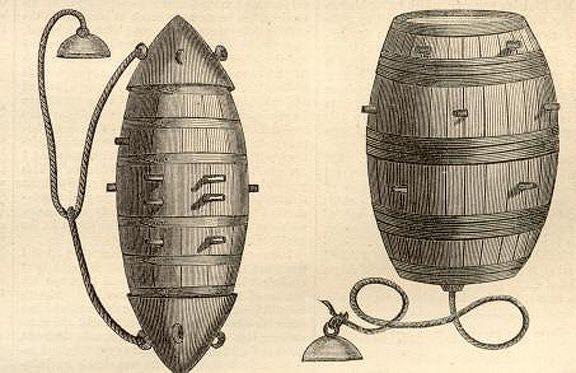
One torpedo design was made from beer casks charged with gunpowder. An iron chain linked to a mushroom-shaped concrete block anchored the concealed mines about two feet below the water’s surface. “Our torpedoes were very rude,” recalled Mobile’s Confederate Commander, Major General Dabney H. Maury. “Some were demijohns charged with gunpowder. The best were beer kegs loaded with gunpowder and exploded by sensitive primers.” A vessel passing over them triggered an explosion that would blow a hole through the bottom and sink her. Maury contends that in the defense of Mobile, “But for the torpedoes, Farragut’s fleet would have greatly embarrassed the defense. But they could only use their guns of the greatest range because all of them who ventured close in were sunk.” [2]
On August 5, 1864, the ironclad monitor USS Tecumseh became the first victim of torpedoes during the Battle of Mobile Bay. The Tecumseh sank to the bottom of the shipping channel, and over 90 sailors were killed. The USS Narcissus became the next vessel to hit a submerged mine on December 12, 1864.
To defend Mobile in March-April 1865, the Confederates littered the water approaches to the city with torpedoes. On Sunday, March 26, 1865, Union Major General E.R.S Canby’s land forces began their siege of Spanish Fort, Alabama, on Mobile Bay’s eastern shore. During the early part of the siege, Confederate gunboats Nashville and Morgan on Blakeley River inflicted heavy casualties on Canby’s besieging ground forces. However, Admiral Henry K. Thatcher’s formidable 36-vessel fleet could not advance up the river to drive them off. Shallow waters, obstructions, and the removal of countless torpedoes slowed his progress toward Spanish Fort. [3]
On Tuesday, March 28, Thatcher sent five gunboats up the Blakeley River, including four river monitors. About sunset, the gunboats were advancing up the Blakeley River, in an area they swept for torpedoes, to about a mile and a half of Spanish Fort. But then there was a sudden shock and a terrific splash of water – the Milwaukee struck a torpedo on her port side and went down in about ten feet of water in about three minutes. Every sailor survived the explosion, but the powerful gunboat was lost. After the sinking of the double-turreted monitor, the New Orleans Times-Democrat newspaper predicted that the navy would sustain no further torpedo damage since most monitors were equipped with torpedo rakes. [4]
Despite Times-Democrat’s prediction, torpedoes continued to take a toll on the fleet. On Wednesday, March 29, 1865, at two p.m., a torpedo exploded under the bow of the monitor Osage, and the ironclad sank rapidly. Five sailors were killed and twelve wounded. The monitor sank, with only her turret, smokestack, and the U.S. flag at its masthead visible. [5]
Thatcher’s vessels continually swept the channel to fish out torpedoes. Yet, the Confederates put more torpedoes in the water with a drag attached, allowing them to drift down with the current just below the surface, hidden by the muddy water. [6]
On Saturday, April 1, the tinclad Rodolph, Acting Master N. M. Dyer commanding, crossed the Blakeley bar when, at 2:40 p.m., a torpedo exploded under her starboard bow and rapidly sank the tinclad in twelve feet of water. The blast killed four of her crew and wounded seven. Thatcher’s naval forces were profoundly impressed with the destructive capacity of the submerged mines. [7]
On April 8, after a two-week siege, Canby’s numerically superior land forces attacked the northern flank of Spanish Fort and gained a lodgment. They were poised to capture the entire fort and garrison the following morning. However, Thatcher’s inability to advance his gunboats up the Blakeley River in the rear of Spanish Fort allowed most of the garrison to escape. The fleet was understandably wary of torpedoes; in just five days, they lost three gunboats. The torpedoes kept the remaining gunboats out of the Blakeley River and thus enabled the Confederates to evacuate most of their garrison successfully.[8]
Confederate torpedoes in Mobile Bay were remarkably effective in stopping the U.S. Navy from playing a more substantial role in the siege. The demoralizing effect of the torpedoes left a profound impression on U.S. naval personnel. A few months after the war, the captain of the U.S.S. Albatross declared that “the Confederate torpedoes are the greatest invention of the age and will render forts and batteries unnecessary as harbor defenses.” [9]
When Canby planned his attack at Spanish Fort, he expected more support from the fleet. However, Confederate torpedoes neutralized the U.S. Navy’s ability to assist Canby’s land forces. Several more vessels were later sunk long after the Confederates left Mobile. In total, Confederate torpedoes sank ten Union vessels in Mobile Bay, resulting in the deaths of over 120 sailors. Nowhere else in the war did torpedoes accomplish remarkable results like Mobile Bay. [10]
References
[1] James M. McPherson, War on the Waters: The Union and Confederate Navies, 1861-1865 (Chapel Hill: University of North Carolina Press, 2012), 2, 4, 5, 8; James M. McPherson, Drawn with the Sword: Reflections on the American Civil War (New York: Oxford University Press, 1997), 132.
[2] Dabney H. Maury, “How the Confederacy Changed Naval Warfare,” Southern Historical Papers 22 (1894): 78; “In Mobile Bay,” The National Tribune, Oct 13, 1887, 3; Walter G. Smith, Life and Letters of Thomas Kilby Smith, Brevet Major-General, United States Volunteers, 1820-1887 (New York: G.P. Putnam’s Sons, 1898), 383; Dabney H. Maury, “Defence of Mobile in 1865.” Southern Historical Society Papers 3, no. 1 (January 1877) 11; Dabney H. Maury, “Defence of Spanish Fort.” Southern Historical Society Papers 39 (April 1914), 133, 135.
[3] Eugene A. Carr, First Reunion of the Survivors of the Army of Tennessee, And Its Four Corps. Logansport, IN: Wilson, Humphreys & Co., 1892, 26.
[4] Christopher C. Andrews, History of the Campaign of Mobile: Including the Cooperative Operations of Gen. Wilson’s Cavalry in Alabama (1867), 67-68; Official Records of the War of the Rebellion, Volume 49, Part 2, 1168; “From Another Correspondent,” New Orleans Times-Democrat, Apr. 4, 1865, 1. Federal monitors were ironclad vessels with a rotating gun turret.
[5] “In Mobile Bay,” The National Tribune, Oct 13, 1887, 3; Andrews, History of the Campaign of Mobile, 70; “.
[6] “Rebellion in the Gulf States Dead,” Chicago Tribune, Apr 18, 1865, 3; “In Mobile Bay,” The National Tribune, Oct 13, 1887, 3; Andrews, History of the Campaign of Mobile, 70; “The Attack of Mobile,” 8.
[7] Andrews, History of the Campaign of Mobile, 94; Maury, “Spanish Fort,” 135; Maury, “Mobile,” 11; “In Mobile Bay,” The National Tribune, Oct 13, 1887, 3; Truman, “The Siege of Mobile,” The New York Times, Apr 21, 1865, 8.
[8] Edgar W. Jones and C. David A. Pulcrano, Eighteenth Alabama Infantry Regiment (Birmingham: C.D.A. Pulcrano, 1994), 64.
[9] Jones and Pulcrano, Eighteenth Alabama Infantry Regiment, 64; “See Second Page of This Morning’s Picayune,” Times Picayune, Nov 9, 1865, 4; Official Records of the Navy In the War of Rebellion, 22, 14, 120.
[10] Hill, War Papers, 182; Richard Sommers, Email interview, May 6, 2016; Maury, “Spanish Fort,” 135; Maury, “Mobile,” 11; Paul Brueske, “Digging All Night and Fighting All Day”: The Civil War Siege of Spanish Fort and the Mobile Campaign, 1865 (El Dorado Hills, CA: Savas Beatie, 2024), 267-270